4 Keyword Match Types in Google Ads [2026 Edition]
Wondering why your Google Search ads attract clicks but fail to convert? It could be a problem with your keyword match types.
Keyword match types determine when your ads appear and which search queries can trigger them.
For instance, when promoting a client’s digital marketing course, ads can unintentionally trigger searches like “free digital marketing course” or “digital marketing salary,” which attract the wrong audience and lead to low-quality clicks.
This is a common problem for advertisers who rely on broad targeting. When you understand how Google Ads keyword match types work, you can control who sees your ads and when they appear.
That’s why we’re here to discuss the different types of keyword match types and when and how to use the right match type for an effective Google Ads campaign performance.

Keyword match types control how closely a search query must match your keyword before your ad appears.
There are three different keyword match types for Google Ads:
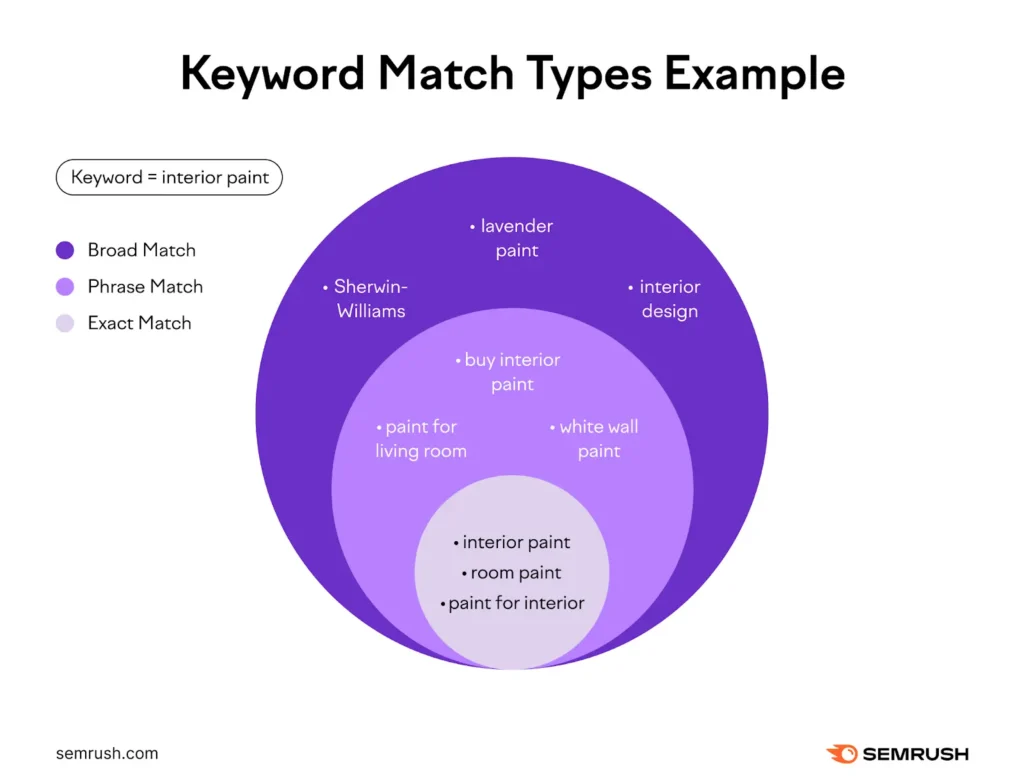
Image credits: Semrush
Broad match is the most flexible keyword match type in Google Ads.
When you use broad match, your ads can appear for search queries that are related to the meaning of your keyword, even if the exact keywords aren’t used. And this is the default match type in Google Ads and works best when paired with smart bidding strategies that optimize for conversions.
For example, if your keyword is iPhone case, your ad shows up for searches like Apple phone case, best iPhone 17 Pro case, or even phone case. It focuses on search intent, which helps you reach customers who want relevant options even if their search phrasing is different.
While using broad match, it’s important to understand both pros and cons. On one hand, it helps you discover new search terms, expand your reach, and gives you a lower cost per click compared to other match types. On the other hand, even if your traffic is wider, but can lead to lower conversion rates without regular monitoring.
Broad match works best when your goal is reach and discovery. It is a good choice when you want Google Ads to explore a wider range of searches and help you understand how customers are looking for your product or service.
You can consider using broad match when you’re:
You should avoid broad match when:
Phrase match is the balance between reach and control in Google Ads.
When you use phrase match, your ads can appear for searches that share the same meaning or search intent as your keyword, even if the exact words aren’t used. While extra words can appear before or after your keyword, the overall intent must stay intact. To use phrase match, you need to place your keyword inside quotation marks, like “iPhone case”.
For example, if your phrase match keyword is “iPhone case,” your ad shows for searches such as “buy iPhone case”, “blue iPhone case”, or “iPhone case sale”.
When using phrase match, it’s important to understand both its strengths and limitations. On one hand, phrase match helps you reach customers whose searches closely match the meaning of your keyword. This gives you relevant traffic and better conversion potential than broad match. It also offers greater control over when your ads need to appear.
On the other hand, phrase match is restrictive. It can limit reach and reduce traffic volume. If your keyword list is too narrow, you may miss out on high-intent searches that broader targeting could capture.
Phrase match is good when you want relevant traffic without being overly restrictive.
Consider using phrase match when:
Phrase match may not be the best option when:
Exact match is the most precise keyword match type in Google Ads.
Unlike broad or phrase match, exact match shows your ads only for search queries that carry the same intent or meaning as your keyword. This includes close variations such as singular or plural forms, common misspellings, abbreviations, and accents, so you still capture relevant searches.
To use an exact match, you place your keyword inside square brackets, like [iPhone case]. For example, if your keyword is [iPhone case], your ad may appear for searches such as [iPhone case], [iPhone cases], or [case iPhone].
While using exact match, it’s important to understand both the pros and the cons. On one hand, it helps you attract highly relevant traffic and reduces wasted ad spend, which leads to better conversion rates and stronger ROI. On the other hand, when your target is too narrow, it limits your reach and can prevent you from capturing broader searches and discovering new keyword opportunities.
Exact match works best when you already know which searches drive results and want your ads to appear only for users with clear search intent.
Consider using an exact match when:
An exact match may not be the best option when:
Negative match keywords are used to exclude your ads from showing for specific search queries, which helps you to focus on reaching the right customers. Your ads will show for relevant search terms and filter out searches that are irrelevant, low-intent, or unlikely to convert.
There are three types of negative keywords:
While using a negative match, you need to understand both the pros and the cons. On one hand, it helps you exclude irrelevant searches, reduce wasted ad spend, and improve the overall quality of traffic. On the other hand, if negative keywords are added too aggressively, you may accidentally block relevant searches and limit your campaign’s reach.
Negative match helps you cut down irrelevant traffic. You need to add negative keywords when you rely on broad match and phrase match keywords.
Use negative match keywords when your keywords:
Choosing the right keyword match types plays a crucial role in Google Ads campaigns. When used strategically, broad, phrase, exact, and negative keywords help you control who sees your ads, reduce wasted spend, and attract customers who are more likely to convert.
But you need to optimize your campaign continuously. You need to test out different match types, review search term data, and refine your strategy to see what performs well.
Want expert guidance for impactful Google Ads campaign performance? Contact NB Marketing Solutions now. We offer end-to-end PPC services that help turn ad spend into measurable business growth.